Most babies cut their first tooth at around six months, though anywhere between four months and their first birthday is within the normal range. The two lower front teeth usually arrive first. Sore gums, heavy drooling and broken sleep are the common signs, and they typically settle within a few days of each tooth breaking through.
Just when you thought you and your baby had mastered breastfeeding, established a comfortable sleeping pattern and happily started solids, out come those little pearly whites!
If we are to be perfectly honest, teething can be tough for any new parent, not to mention their unassuming baby. After all, it turns a once little angel into a screaming, crying ball of drool, leaving new parents begging for answers on how to make this process a tad bit easier for all concerned!
At DP Dental, we are all about general dentistry with a functional twist. We are incredibly passionate about solving problems at the root, even before they manifest as symptoms. Having met many a new flustered parent, our Clinical Director, Dr Yue Weng Cheu, was only too happy to answer some pressing questions on teething.
How can you soothe a teething baby?
Dr Yue: Sometimes, all parents can do is to soothe their little one and keep them comfortable. Babies self-soothe too, putting their fingers in the mouth and rubbing their sore gums. While you can’t stop your baby putting their hands in the mouth, it is essential to manage your baby’s hand hygiene to avoid the possibility of getting an infection from germs entering the mouth.
Some parents may also notice their teething baby drooling excessively. This drooling is simply a reaction to the changes happening in the baby’s mouth. While there isn’t much you can do to reduce this, gently wiping your baby’s mouth with a clean cloth will keep the mouth area clean.
Occasionally parents may notice their baby having a slight fever. Keep in mind that inflammation isn’t an infection. Inflammation is a natural reaction when the teeth erupt, breaking through the gum. Once the tooth has erupted, the inflammation should subside.
When to see a doctor: teething itself does not cause a high temperature. If your baby’s temperature reaches 38°C or above, or they seem unwell beyond the usual teething discomfort, have them checked by a doctor rather than putting it down to teething.
Can teething rings be used, and are there any other options?
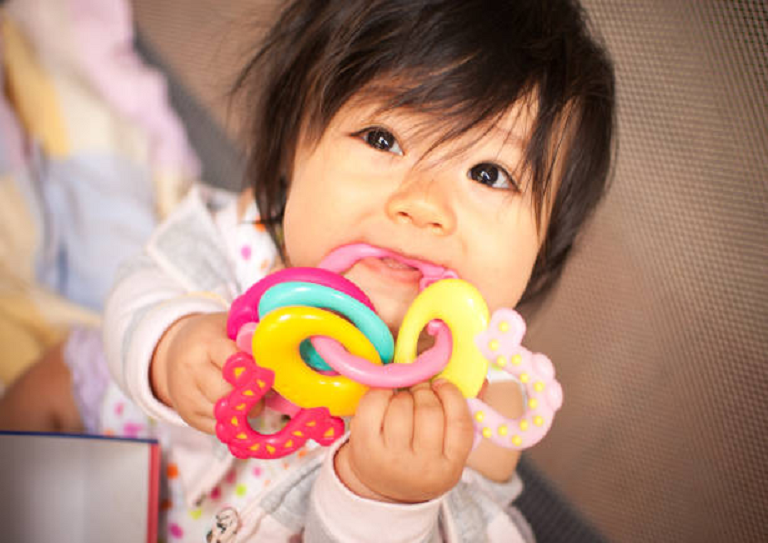
Dr Yue: Definitely. Both hard biscuits and teething rings encourage babies to chew. I strongly encourage parents to allow babies to continue to chew because, during this stage, babies are developing the ability to chew. That chewing frequency can contribute to the growth and development of their jaw muscles.
Talking about muscle development, I encourage breastfeeding mothers to continue to persevere on. Breastfeeding helps develop a proper lip and tongue position and helps with excellent breathing habits early on in life.
Furthermore, certain ingredients in breastmilk and your baby’s saliva are very beneficial for healing teething inflammation. Some lactation consultants recommend making breastmilk ice pops and giving it to your baby to suck on.
“Breastfeeding helps develop a proper lip and tongue position and helps with excellent breathing habits early on in life.”
Should you bring your baby to see a doctor or a dentist when they’re experiencing pain?
Dr Yue: Unfortunately, as painful as it is to watch your baby struggle through teething, apart from keeping your baby comfortable, there not much else you can do. I usually advise parents to let nature take its course and to manage inflammation.
Should you be worried if your baby hasn’t started teething by six months?
Dr Yue: This isn’t a big issue to be concerned about. Timing of teething can vary a fair bit, and it’s absolutely normal for babies even to start teething towards their first birthday. My son started teething only at nine months. Interestingly, when it comes to teething, Chinese culture says the later, the better!
Can you do anything if your baby’s teeth are coming in crooked?
Dr Yue: It is essential to understand that the position of teeth depends on the oral function of the lips, tongue and cheek. Keep in mind that the way the baby teeth enter does not determine their final position.
So if you notice your baby’s teeth are not straight, then we have to make sure that the function of the tongue is correct. Of course, there’s some genetic component to it, but it is not the only thing. We can still use habit correction to ensure a better outcome of growth and development of the jaw and for the better alignment of teeth.
“Keep in mind that the way the baby teeth enter does not determine their final position.”
Is it normal that my baby has gaps in between their teeth?
Dr Yue: While you shouldn’t be too concerned about alignment and crooked teeth, be watchful of whether there are enough gaps between the teeth. It is quite normal for babies to have gaps between their teeth. They are known as primate spaces.
These primate spaces indicate that the jaw is growing wide enough. When adult teeth come in, they will fill in these gaps. So if there are gaps between the teeth, you can expect the new tooth to come through straight. However, suppose the baby teeth are fit tightly together. In that case, the adult teeth may need to squeeze out and sometimes they have to rotate or erupt in an ectopic position to make its way up to the oral cavity.
Should you allow your baby to suck their thumb when teething?
Dr Yue: We don’t recommend thumb or pacifier sucking. Prolonged thumb sucking or sucking on a pacifier can induce a low tongue position. The suction force from the cheek and the pushing of the tongue against the palate and the teeth will stop the oral structures from growing optimally.
Have more questions about your child’s teeth? Message DP Dental on WhatsApp and we will get back to you.



Recent Comments